Summer Wedding Guest Dresses
The summer wedding calendar asks more of a guest's wardrobe than any other season. A modern guide to dressing for garden, coastal, black tie, cocktail, and destination weddings — organized by occasion.
13 min read
Five weddings. Four months. One wardrobe.
The summer wedding calendar — garden ceremonies, coastal receptions, black tie evenings, destination weekends — asks more of a guest's wardrobe than any other season. Not because the dress codes are stricter, but because each context demands something different from the fabric on her body. Heat. Movement. Drape. Recovery. The right dress is built for all four. What follows is COCOSIN's edit.
Summer wedding guest dressing depends on four variables: dress code, venue, climate, and re-wearability. The right dress works across multiple weddings in one season — a garden ceremony in June, a coastal celebration in July, a black tie reception in August. Fabric is the deciding factor: breathability, drape, and recovery determine whether a dress survives one occasion or four.
Most summer wedding guest dresses disappoint for the same reason: fabric. A $250 dress in unbreathable polyester chiffon sweats through the ceremony, clings at the reception, photographs heavy under direct sunlight, and survives one wedding before retiring to a closet. The category's most-cited customer complaint across every premium competitor is identical — "feels like Shein." The disappointment is not bad luck. It is the structural economics of fast-cycle production at scale.
COCOSIN's wedding-guest edit begins from a different starting point: fabric first, silhouette second. Every piece is produced in the brand's atelier by makers who have spent careers in the workrooms of some of the world's most recognized fashion houses. The signature material — AirMesh™, a body-adaptive stretch mesh — was developed specifically for the problems summer wedding guests face: breathable in heat, sculpting without compression, fluid without sheerness, flattering across body types, and capable of holding its shape through a long evening in unfamiliar light. The result is a small collection of pieces built to work across the summer calendar, not to be replaced after each event.
What follows is COCOSIN's summer wedding edit, organized by the five occasion types that account for nearly every summer invitation: a garden ceremony, a coastal wedding, a black tie reception, a cocktail attire reception, and a destination weekend. Each section pairs one anchor dress to the occasion it serves best — and shows how the same fabric and silhouette adapt across colorways to meet different sub-contexts within that occasion.
The Garden Ceremony
Under a marquee, at noon

The two priorities at a garden wedding are heat and natural light. The ceremony usually runs at noon or in the early afternoon — vineyards in Sonoma, walled gardens in Charleston, farmhouses in Provence in late June when the lavender is still photographing well. The images that come out of those events are bright, with soft greenery and stone as the backdrop. The dress has to do two jobs that don't always agree: hold up in heat, and read clearly in natural light against that softer background.
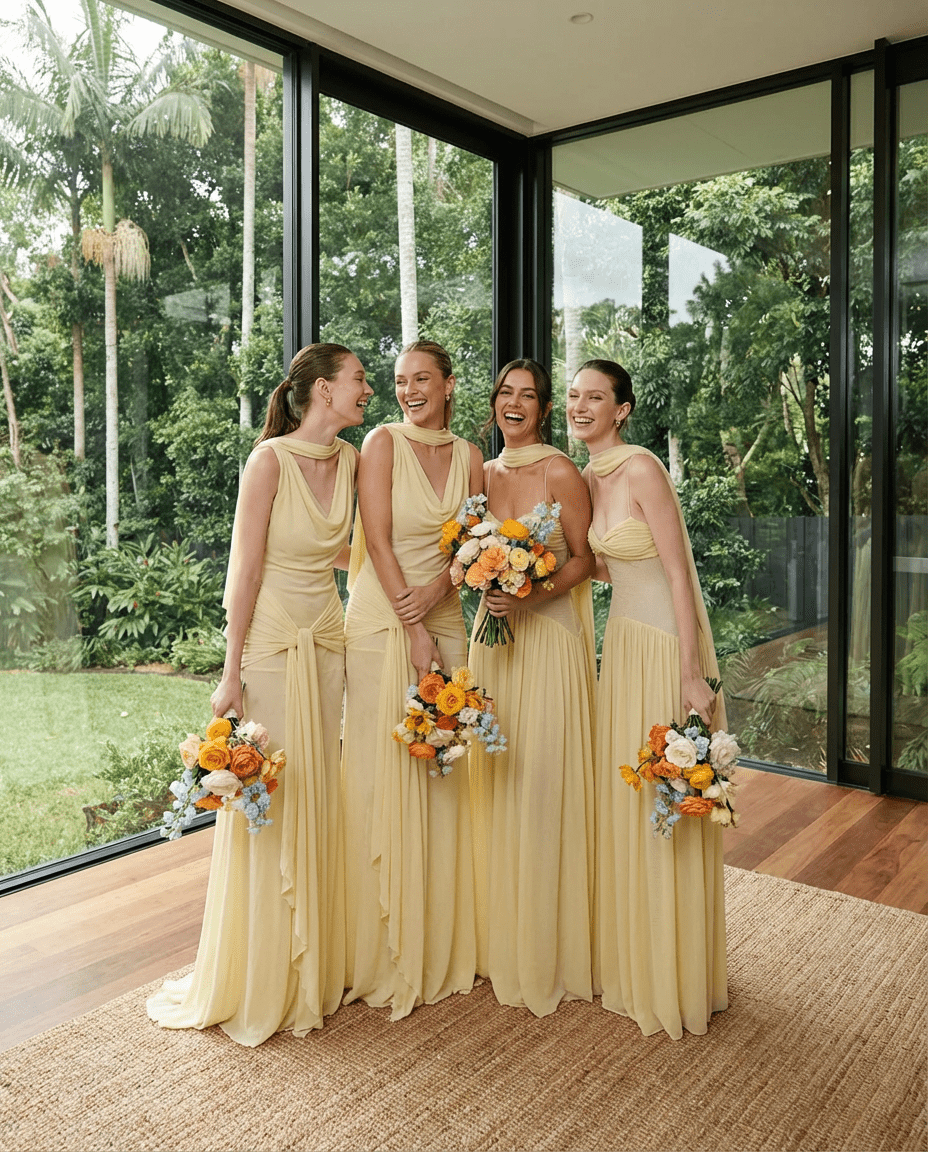
The right anchor for this context is The Solène Drape Maxi — the most-photographed and most often re-worn piece in COCOSIN's wedding edit, and the dress that has anchored the brand's editorial since the launch of its Resort Collection. Its fabric is the signature stretch mesh: it drapes like silk, breathes like jersey, and resists the sweat-print problem that defeats most "premium" wedding-guest fabrics. The construction is built around a sculpted cowl neckline, soft gathers at the waist, and an attached scarf detail that flows behind or ties at one shoulder. The piece is designed to move with daytime garden breeze rather than fight against it — fluid in profile, photograph-ready in motion.
The Solène, in three colorways
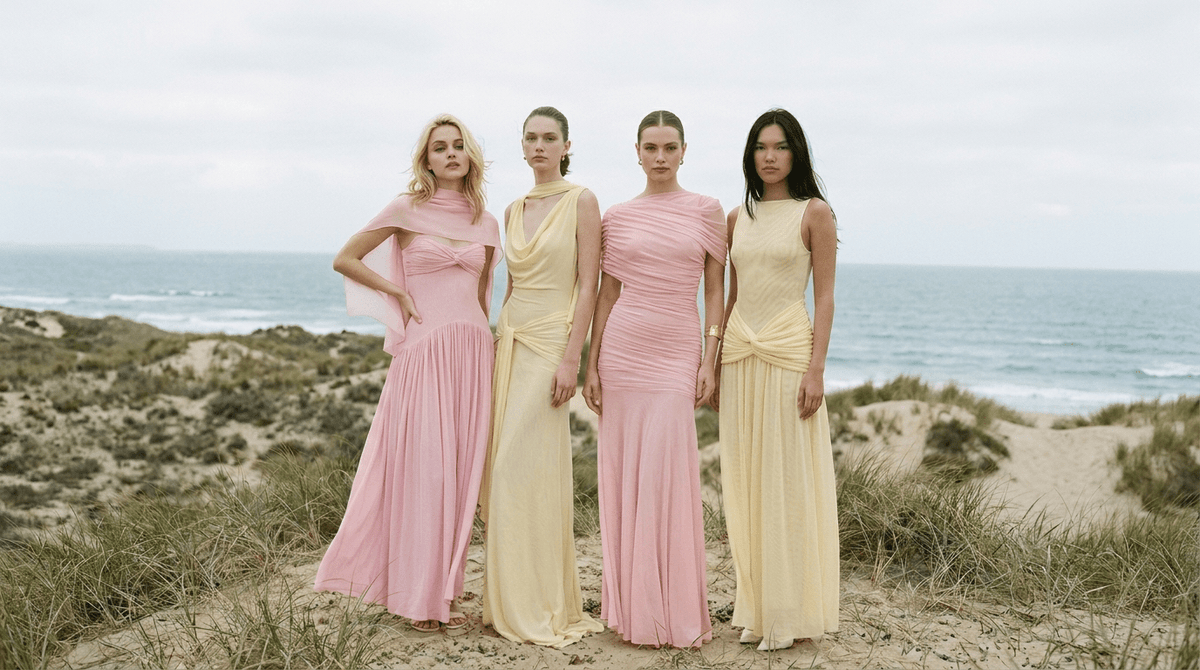
Buttery yellow — the iconic colorway. For garden ceremonies in full sunlight — late-morning vow exchanges, midday cocktails, golden-hour receptions. Yellow photographs warmly against greenery and stone, signals dressing-for-the-place rather than against it, and is the colorway customers most often re-wear beyond the wedding itself. The version COCOSIN recommends first for the majority of garden contexts.
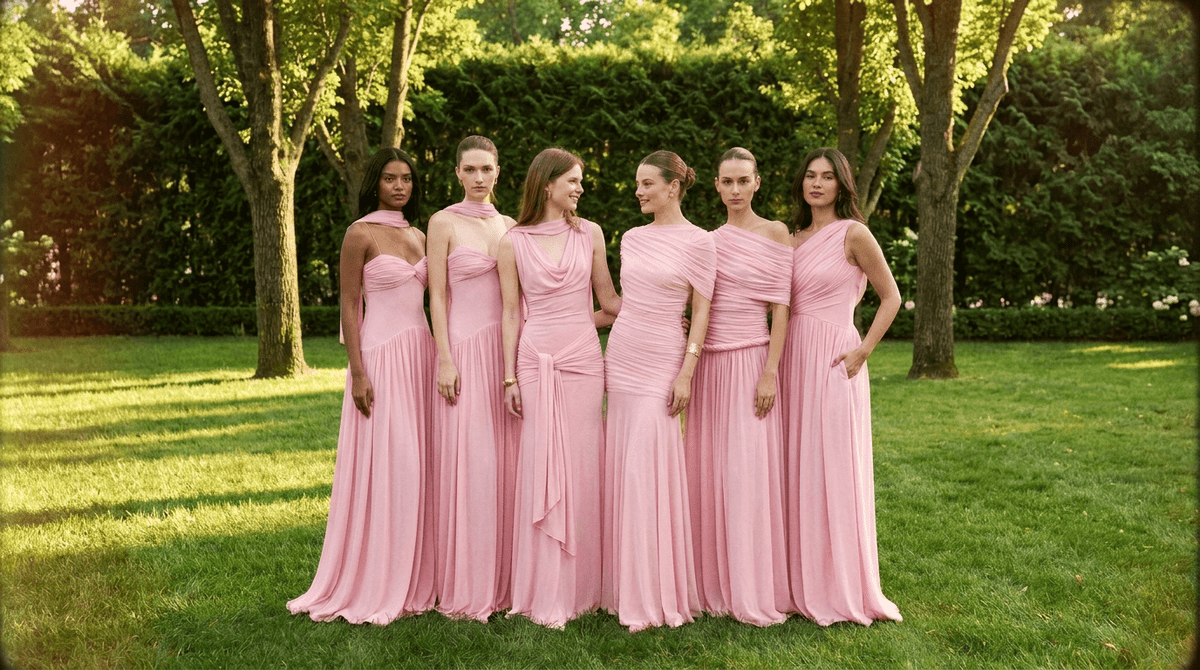
Peach blossom pink — the soft alternative. The right choice when the bridal palette skews ivory or champagne. Pink in this construction reads romantic without reading bridal, sitting comfortably alongside the bride's color story without competing with it. Particularly strong at venues built around stone, brick, or pale wood — settings where yellow can occasionally get lost in the background.
Burgundy red — the evening shift. For late-afternoon ceremonies that carry into formal evening receptions. As the daylight fails, burgundy holds the formality in a way the lighter colorways cannot. The right choice when the venue is more architectural than pastoral — a country estate rather than a meadow, structured hedging rather than wildflowers.
The Solène Drape Maxi →The Coastal Wedding
Salt-air receptions

Coastal weddings present their own design problem. There is salt in the air, sand at the hemline, humidity at every photograph, and often a 20-degree temperature swing between the outdoor 5 PM ceremony and the indoor 9 PM reception. The dresses that fail at these weddings are the ones that do not account for movement — strapless gowns that need constant adjusting in breeze, satin dresses that show every sweat mark, fabrics that wrinkle the moment a guest sits down to dinner.
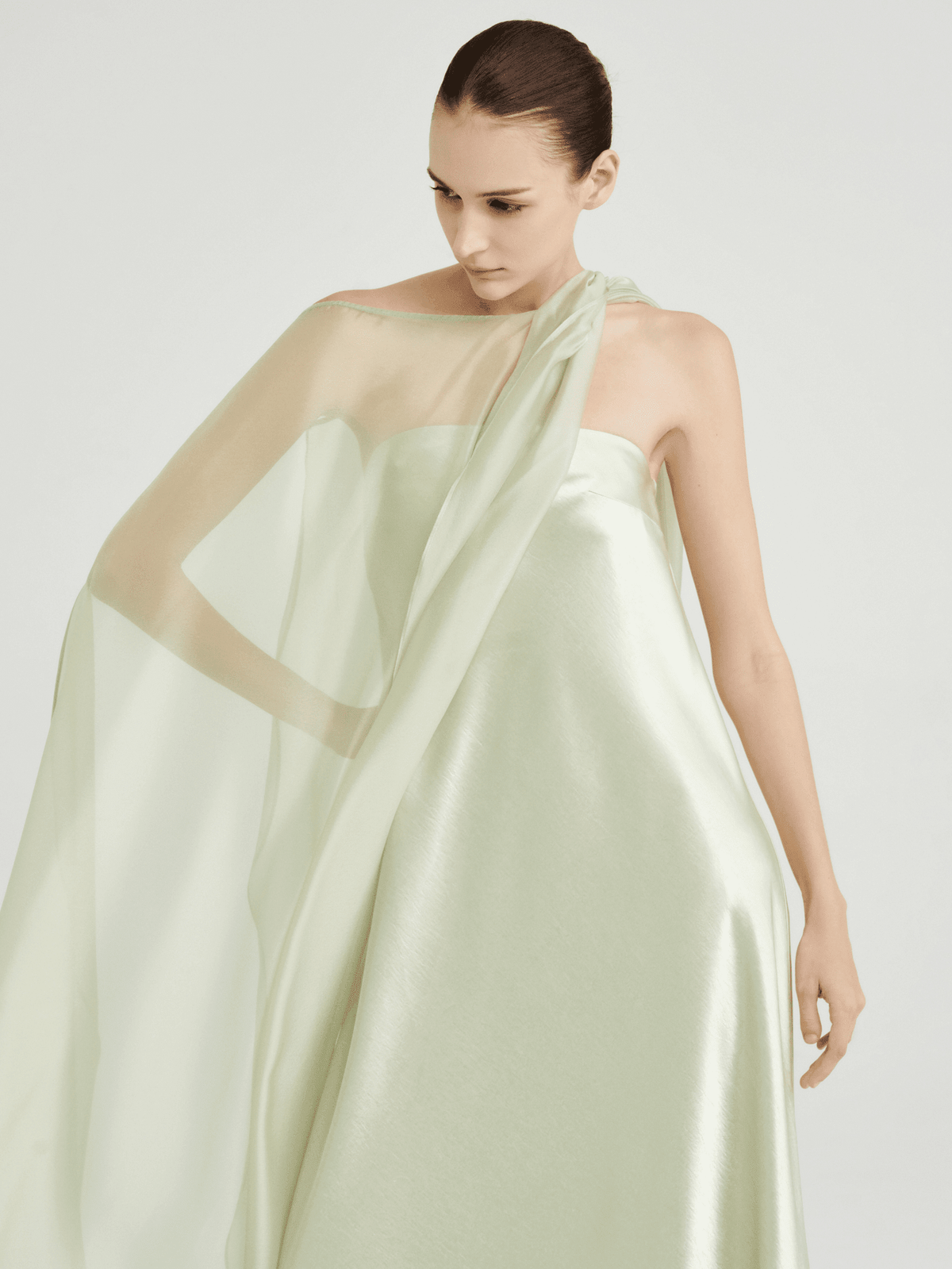
COCOSIN's answer for this specific climate is the Strapless Satin Maxi with Sheer Cape Overlay. The piece is designed around a strapless satin column that holds its line against breeze instead of billowing into it, paired with a sheer cape that is attached but removable — drama for the ceremony, gone for the dance floor. The cape carries the visual work; the satin underneath carries the practical work of staying cool. Satin reads as formal, but in this construction the strapless cut and detachable cape work specifically with warm weather rather than against it.
Three colorways for the coast
Peach blossom pink — the coastal-romantic. The colorway built for sunlit, sandy contexts. Pink in this fabric — glossy satin under sheer overlay — reads warm rather than sweet, and photographs beautifully against turquoise water, pale sand, or Mediterranean stone. It is the colorway customers most often wear with the cape removed for the reception itself.
Buttery yellow — the sun-coded. For beach ceremonies in full midday sun. Yellow photographs warmly against pale sand and white linen tablescapes. The most-distinctive of the three colorways, and the one that most clearly signals intentional dressing — that the guest dressed for the place, not just the dress code.
Black — the evening-into-night. For coastal weddings with later reception timing or cooler-climate beaches — Hydra in October, the Hamptons in September, Mendocino or Big Sur after sundown. In this fabric, black holds the formality the satin demands without weighing the silhouette down. The right choice when the venue is more formal than relaxed, and the reception shifts indoors after sunset.
Strapless Satin Maxi with Sheer Cape Overlay →The Black Tie Reception
The evening address

Black tie weddings happen in specific kinds of rooms. A country club outside Greenwich. A villa overlooking Lake Como. A private museum dining room in Charleston with chandeliers and candlelit table settings and a string quartet that opens the reception. The dress code asks for floor length, structure, and a colorway register that respects the formality of the room. What it increasingly asks for, especially from the modern guest, is an alternative to the corseted bandage gown that the category has trained customers to expect.
The Muse Mesh Halter Gown is COCOSIN's answer for contemporary black tie — and for the rising category of black tie optional that now accounts for a substantial share of summer evening receptions. The piece is cut from the brand's airy spandex mesh because a dress at this register should drape with the fluidity of Greek-statue robing rather than the structure of traditional evening wear: formal presence without architectural constraint. The twisted sweetheart neckline and halter tie detail read as architectural without being restrictive. The gathered full-length skirt moves with the music. Customers have worn the Muse to strict black tie weddings, black-tie-optional receptions, and gala dinners — the same dress, credibly, at three different dress codes. One customer described it as feeling "not overdressed, not underdressed."
Three colorways for the evening
Black — the unambiguous. For traditional black tie receptions where the dress code is explicit and the venue is formal — country clubs, hotel ballrooms, evening receptions under chandeliers. In this fabric, black reads fluid rather than heavy, and the halter construction keeps the silhouette from disappearing into the background of an evening reception. The default when the wedding is strict.
Buttery yellow — the modern register. For the black-tie-optional guest who wants to make a confident colorway choice without reading as underdressed. Yellow in floor-length fluid mesh is not casual — it is fashion-considered. A statement that the wearer understood the dress code and chose to interpret it.
Peach blossom pink — the warm-evening choice. For destination black tie or vineyard evening receptions where the palette has loosened. Pink in floor-length AirMesh photographs beautifully under low evening light, and feels appropriate at venues where the black-tie convention is real but no longer architectural — late-summer destination weddings, indoor-outdoor venues, vineyard receptions at dusk. The register customers describe as soft drama rather than formal drama.
Muse Mesh Halter Gown →The Cocktail Attire Reception
Between ceremonies

Cocktail attire is the most ambiguous of the wedding dress codes. It sits somewhere between cocktail-formal and garden-casual depending on the venue, the time of day, and how the bride interprets the phrase on her own invitation. Most cocktail attire summer weddings happen at rooftops in Brooklyn, walled gardens in Notting Hill, or townhouses in Charleston — late-afternoon receptions that run from cocktails into dinner into dancing. The dresses that work for these weddings are polished without being floor-length, distinctive without being attention-seeking.
The Amélie Polka Dot Satin Dress is COCOSIN's answer for this register. The silhouette is a midi — knee-just-below, the tea-length sweet spot of cocktail propriety: long enough to be wedding-appropriate, short enough to move at a rooftop reception in August. The fitted bodice and spaghetti straps read vintage-coded without crossing into costume. And the pattern — cream ground with bold black polka dots — is one of the most photogenic prints at a wedding: high-contrast clarity that holds up in any lighting.
The dress reads French-cinema cool rather than fashion-forward. That register is deliberate. The COCOSIN customer this piece was designed for wants to look intentional without trying. Side pockets — included after consistent feedback from women wearing dresses to weddings — are the kind of detail that turns a dress from acceptable to beloved.
The Amélie comes in this one colorway only. The pattern is the colorway.
Amélie Polka Dot Satin Dress →The Destination Wedding
Three days, one carry-on

A destination wedding rarely calls for one dress — it calls for two or three. A welcome dinner the night of arrival, the ceremony itself, an after-party at the resort bar, a farewell brunch the next morning. The destination guest's real problem is luggage capacity, not dress selection. The right destination piece packs flat, recovers from a flight, transitions across multiple events in a single trip, and photographs in unfamiliar light — Mediterranean midday, Caribbean sunset, Moroccan stucco, Portuguese stone. The lighting changes every time.
The Dune Glow Dress is the piece COCOSIN designed for exactly this problem. The fabric is the brand's spandex mesh in a soft sand tone — a colorway that photographs in any palette, from Capri blues to Caribbean turquoise to Mediterranean terracotta. The silhouette is a relaxed turtleneck with draped dolman sleeves and a floor-length column, finished with a gathered low-back cowl that reveals just enough skin to balance the coverage at the front. The dress was built for resort dinners, evening events, and gallery nights with a modern edge — which is to say, the exact mix of contexts that compose a destination wedding weekend. It packs flat. It recovers from a flight. It looks like the guest dressed for the place.
A complete COCOSIN destination capsule is not one dress — it is two or three pieces from this edit, in colorways that work across the weekend's contexts. The Solène in buttery yellow for the welcome dinner under string lights. The Strapless Satin with Cape Overlay in peach blossom pink for the ceremony itself. The Dune Glow in sand tone for the farewell brunch and the long flight home. Three pieces, one carry-on, a wardrobe that handles a four-event weekend in Capri or Marrakech or Comporta — and then re-wears for the next two years of weddings.
That is the brief COCOSIN designed against. Not one dress, four times. A small wardrobe, twenty times.
Dune Glow Dress →Summer Wedding Guest Dress Questions, Answered
What is appropriate to wear as a wedding guest in summer?
Summer wedding guest attire depends on the dress code stated on the invitation. For garden and beach ceremonies, midi and maxi dresses in breathable fabrics — stretch mesh, silk, lightweight crepe — are standard. Evening receptions typically call for cocktail or formal attire, with floor-length silhouettes appropriate for black tie. Avoid white or anything that visually competes with the bride. Lighter palettes are summer-appropriate for daytime; richer colors work for evening.
What fabrics are best for a summer wedding guest dress?
Breathable fabrics that drape rather than cling. Spandex mesh, lightweight silk, satin with a sheer overlay, and structured cotton all work well in summer heat. Avoid heavy crepe, polyester chiffon (which traps heat and shows perspiration), and stiff structured fabrics that bunch in humidity. The right summer fabric photographs fluid, breathes through a long ceremony, and recovers from being sat in.
Can I wear a long-sleeve dress to a summer wedding?
Yes — particularly for evening receptions, cooler-climate summer venues, or weddings with cultural or religious modesty conventions. Long sleeves in lightweight mesh or silk add elegance without heat. The key is fabric weight: a long sleeve in heavy crepe will feel oppressive, while a long sleeve in airy mesh reads as architectural rather than warm. Long-sleeve summer wedding guest dresses are an increasingly common search and an increasingly common style choice.
How do I dress for an outdoor summer wedding ceremony?
Three priorities: breathable fabric, sun-friendly silhouette, and footwear that handles the ground. For garden ceremonies, midi or maxi dresses in stretch mesh or silk work well. For beach ceremonies, avoid stiff bodices and floor-dragging trains. Halter and one-shoulder necklines tolerate sun better than strapless. Lighter palettes — pastels, neutrals, soft yellows — photograph well in direct sunlight. Always avoid pure white.
What colors should I avoid wearing to a summer wedding?
Pure white is universally reserved for the bride. Off-white, ivory, cream, and predominantly white patterns extend this rule. Beyond white, summer weddings welcome most colors — pastels, jewel tones, and deeper richer colors for evening. The other color to use cautiously is bright red, which some traditional brides find attention-drawing. When in doubt, check the invitation's stated palette or ask someone in the wedding party.
Is a maxi dress appropriate for a summer wedding?
Yes — maxi dresses are the most versatile summer wedding guest length. They work credibly across garden ceremonies, beach receptions, black tie evenings, and destination events. The only constraint is fabric: a heavy maxi in summer heat reads as inappropriate, while a maxi in stretch mesh or silk handles the climate beautifully. Floor-length is required for black tie; near-floor or tea-length is acceptable for cocktail attire.
How do I choose between a midi and maxi for a summer wedding?
Midi length (knee to mid-calf) works best for cocktail attire receptions, garden parties, and afternoon ceremonies. Maxi length (floor or near-floor) is the safer choice for black tie, formal venues, destination weddings, and evening receptions. When in doubt, maxi reads as more formal and more photograph-ready. Tea-length (just below midi) is the sweet spot for cocktail-leaning summer weddings.
Can I wear black to a summer wedding?
Yes — black is widely accepted as a wedding guest color, particularly for evening, black tie, and cocktail receptions. In summer specifically, black can read overly heavy for daytime garden or beach weddings, where lighter palettes photograph better. For evening summer receptions, black in lightweight mesh or silk is appropriate and elegant. The exception is some traditional or daytime summer weddings, where black can feel out of register.